
Fasting and Rediscovering the importance of therein!

1. An “Average” Across Religions: When Humans Most Often Fast
When you look across major religious traditions globally (Christianity, Islam, Judaism, Hinduism, Buddhism, Jainism, Baháʼí, Eastern Orthodox, etc.), several clear temporal patterns emerge.
A. Seasonal Convergence
Across religions, fasting most often clusters in two windows:
Late Winter → Early Spring
Christian Lent (February–April)
Jewish Purim fasts and Passover‑related fasts
Baháʼí Nineteen‑Day Fast (early March)
Many Hindu austerity periods (e.g., Maha Shivaratri, seasonal vrata)
Buddhist pre‑rainy‑season observances
This concentration is well documented across comparative religious calendars [en.wikipedia.org], [calculatorian.com], [holidayfyi.com]
Interpretive average:
Humans historically fast as winter ends and metabolism transitions toward spring.
Late Summer → Early Autumn
Jewish Yom Kippur and Tisha B’Av (August–October)
Islamic Ramadan cycles through all seasons over ~33 years, but historically originated in hot months
Orthodox Christian Dormition Fast (August)
Jain Paryushana (Aug–Sept)
Hindu Shravan fasting
Again, this clustering appears consistently in interfaith calendars [calculatorian.com], [npolls.com]
Interpretive average:
A second global fasting window aligns with harvest completion and physiological recalibration.
B. Daily Timing Patterns
Across religions, fasting most often follows circadian alignment:
Dawn → sunset fasting (Islam, Baháʼí, Judaism on minor fasts)
Early‑day eating, evening abstinence (Buddhist monastic rules)
One main daily meal late in the day (Orthodox Christianity)
This convergence strongly mirrors modern time‑restricted eating models [calculatorian.com], [aleteia.org]
Religious Average Summary
If we “average” all faiths:
Dimension | Human Universal Pattern |
Season | Late winter→spring & late summer→autumn |
Daily rhythm | Eat earlier, fast later |
Purpose | Purification, clarity, vascular “opening” metaphors |
Intensity | Cyclical, not constant |
2. Scientific Consensus: When Fasting Best Supports Venous Health
Here we shift from symbolism to physiology.
A. What Venous Health Actually Depends On
Venous and vascular health depend on:
Endothelial function
Nitric oxide (NO) availability
Low systemic inflammation
Good circadian signaling
Venous return efficiency (muscle pump + vessel elasticity)
These mechanisms are explicitly linked to fasting in modern research [pubmed.ncb...lm.nih.gov], [mdpi.com]
B. Seasonal Biology & Fasting
Human vascular biology shows seasonal variation:
Nitric oxide production tends to increase in spring
Inflammatory markers peak in late winter
Blood viscosity is higher in cold months
Fasting during late winter → early spring appears to:
Improve endothelial nitric‑oxide signaling
Reduce arterial stiffness
Improve venous tone via reduced oxidative stress
This is consistent across intermittent fasting reviews and Ramadan‑focused vascular studies in healthy populations [pubmed.ncb...lm.nih.gov], [mdpi.com]
C. Best Daily Timing (Science Mirrors Religion)
From vascular physiology:
Most beneficial fasting windows for venous health:
14–18 hour overnight fasts
Early eating → evening fasting
Avoid late‑night caloric intake (venous pooling worsens at night)
Clinical and randomized trials show improvements in:
Flow‑mediated dilation
Nitric oxide bioavailability
Reduced endothelial inflammation [zenodo.org], [ajmcrr.com]
D. Important Safety Note
Some populations (e.g., uncontrolled diabetes) may not benefit from long fasting windows without supervision; one large cohort study shows neutral or adverse endothelial effects in diabetics during Ramadan [frontiersin.org]
3. A Sound‑Based Mindfulness Practice for Venous Health
Below is a fully written, ready‑to‑record audio script. It blends:
Interfaith fasting wisdom (without religious language)
Modern vascular science
Breath, imagery, and venous return cues
“The Circulation Practice” (12–15 minutes)
Opening (Grounding)
“Find a comfortable seated or reclined position.Let your legs rest heavy. Let gravity be your ally.”
(10 seconds of silence)
Breath Phase: Venous Return Activation
“Breathe in slowly through the nose…Feel the breath expand in the belly. As you exhale, imagine the veins in your legs softening, gently returning blood upward toward the heart.”
(Repeat for 6–8 cycles)
This mirrors muscular pump physiology and improves venous flow.
Seasonal Awareness (Interfaith Layer)
“Across civilizations, humans have paused during times of transition—when winter turns toward spring,or when summer gives way to harvest. These pauses were not about deprivation,but about clearing the pathways.”
(Pause)
Visualization: Nitric Oxide & Flow
“With each exhale, imagine warmth in the vessels. A quiet widening.A freedom of movement. The inner lining of your veins releases ease…allowing blood to glide rather than push.”
This directly references endothelial nitric‑oxide signaling without naming it.
Fasting‑Aligned Intention
“For the next hours, or the next day,allow space between inputs. Not as discipline—but as invitation. Space allows repair.”
Closing
“Movement returns upward.Clarity returns inward. When you are ready, gently open your eyes.”
Venous health remains one of the most underexamined and least discussed foundations of human longevity. Modern health discourse has long centered the heart and arterial disease, often overlooking the venous system—the extensive return network responsible for transporting blood, metabolic waste, and spent nutrients back toward the heart. This imbalance has consequences. Unlike arteries, which rely on pressure generated by the heart, veins operate through subtler mechanisms: vessel elasticity, muscular movement, breath‑driven pressure changes, and precise blood chemistry.
When venous flow slows or stagnates, the body does not fail explosively; instead, it degrades quietly. Congestion accumulates. Waste clears less efficiently. Nutrition travels more slowly. Over time, what appears as vague fatigue, inflammation, or “normal aging” is often the result of impaired return flow rather than primary organ failure.
Emerging insight now suggests that the venous system requires far more upkeep, rhythm, and intentional care than previously assumed. Because veins work against gravity and depend so heavily on movement and blood quality, they are especially vulnerable to chronic dietary strain. Thickened blood, excessive fats, and constant metabolic load place an ongoing burden on venous return, particularly in the smallest and most distant vessels of the body.
These micro‑branches—especially in the limbs—are often the first to narrow, clog, or lose function altogether. This process does not typically begin in advanced age. Increasingly, the earliest stages of plaque buildup and microvascular loss appear in the late twenties and early thirties, well before symptoms are dramatic enough to attract attention.
As these smallest venous pathways begin to close or die away, the system compensates. Blood is forced through fewer routes. Pressure increases. Distribution becomes uneven. Some tissues receive ample nutrition while others are quietly deprived. This redistribution creates a misleading narrative: that energy loss, cold extremities, slower recovery, or reduced tissue resilience are simply milestones of getting older.
In reality, many of these changes may reflect premature restriction—nutrients no longer reaching their destination because the venous exits have narrowed. The problem is not always what the body lacks, but where circulation can no longer deliver what it already has.
Seen through this lens, the dietary wisdom encoded in many religious and cultural traditions takes on a new clarity. Across civilizations, entire categories of foods were labeled “unclean”—not merely for moral or environmental reasons, but through long observation of how certain foods behaved in the body over time. Pork, for example, was often avoided not only because of visible hygiene concerns, but because of its dense fat content and the way repeatedly consumed greasy foods burden circulation.
Excess fats rarely damage all at once; instead, they accumulate slowly, thickening blood and stressing vessels increment by increment. In this way, highly greasy and fatty foods act much like tar in the lungs from smoking—a quiet, slow killer whose consequences emerge only after years of accumulation.
This framing forces a more uncomfortable but necessary shift: certain modern food patterns can no longer be regarded as neutral indulgences. In the context of venous health, they function more accurately as slow‑acting poisons. Not poisons because they are immediately lethal, but because they disrupt the body’s ability to disperse life‑sustaining nutrition. When circulation becomes compromised, calories alone lose meaning.
Cells starve while the bloodstream appears full. This helps explain why so many people enter their thirties with chronic fatigue, unexplained inflammation, or diminished vitality despite eating enough—or even excessively. What was once attributed to age may instead be the cumulative cost of dietary strain placed on the venous system.
From here, the importance of fasting becomes unavoidable. Fasting is not best understood as denial or deprivation, but as a clearing mechanism—a necessary pause that allows the venous system to reduce congestion, restore elasticity, and reopen its smallest channels. Just as lungs require clean air to regenerate, the vascular system requires clean inputs and periods of metabolic rest to recover. But fasting alone is not sufficient. What matters just as profoundly is what follows the fast. If food re‑enters the body as burden rather than support, congestion quickly returns.
In this light, food must be redefined. No longer primarily a source of pleasure or stimulation, it becomes medicine in the most literal sense: the raw material used to rebuild vessels, restore flow, and influence cellular expression over time—including DNA signaling itself.
When food is approached with this level of seriousness, its purpose shifts from indulgence to restoration. Eating becomes an act of circulatory stewardship. Fasting becomes an act of respect. And health is reclaimed not through force, but through alignment with the body’s quiet, persistent logic.
Below is a visual of this process:
Flow depends on reach, not force.
Meaning: The system works when blood can reach the smallest destinations effortlessly. Health is distribution.
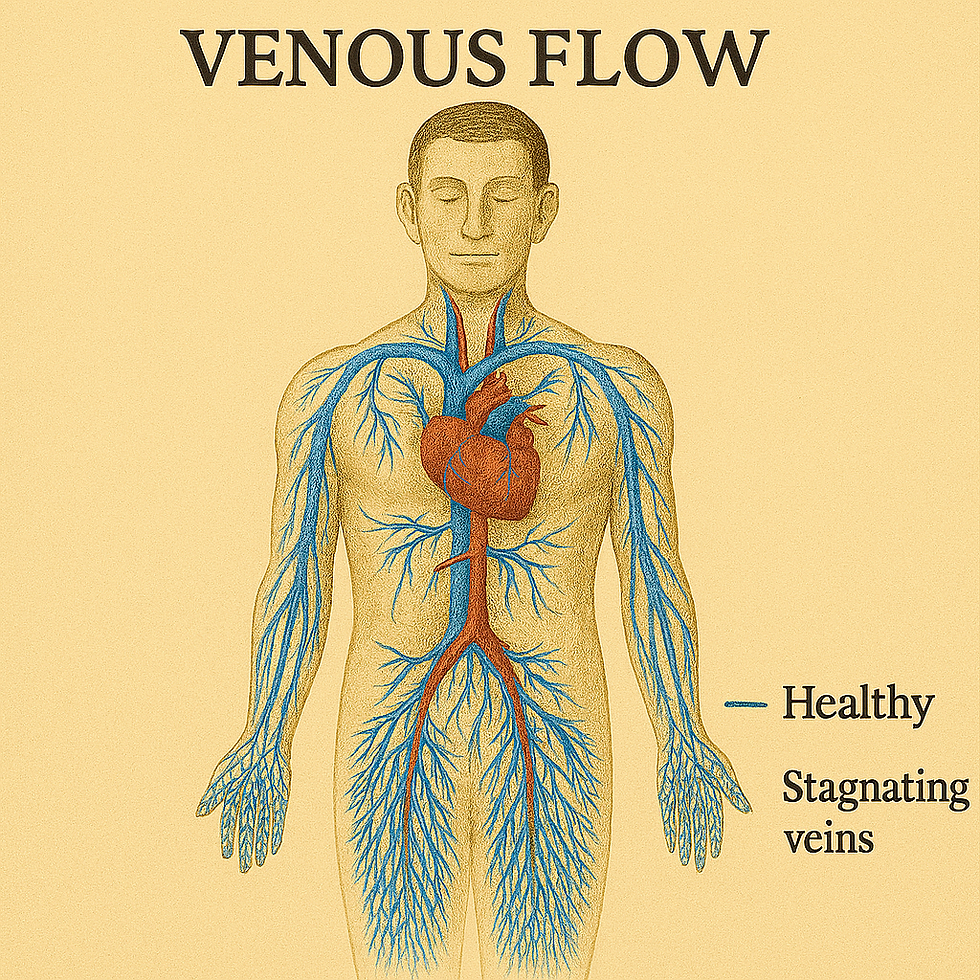
Breakdown begins at the edges.
Meaning: Loss starts in the smallest tributaries long before major vessels fail. What looks like aging is often early venous attrition.

Space restores capacity.
Meaning: When metabolic load is removed, marginal pathways reopen. Recovery is partial, directional, and earned. Fasting and Diet are ESSENTIAL parts of our lifestyle that we have forgotten! This is the key to health, vitality, and LONGEVITY!

The Longevity Implications of Protecting Venous Health Early
1. Prevention, Not Repair, Is Where the Leverage Lives
The most profound implication of early venous care is that it prevents loss rather than attempting to reverse it. Once micro‑tributaries collapse or are fully lost, the body can compensate, but it rarely recreates original vessel density. By preserving venous integrity in the teens, twenties, and thirties—through metabolic rest, clean inputs, and circulation-aware habits—you retain distribution capacity that most people gradually forfeit without noticing.
In practical terms, this means:
Lower baseline blood pressure later in life
Less systemic inflammation
Reduced strain on the heart over decades
Longevity, in this frame, is not about living longer at the end—it’s about slowing the rate of internal attrition early.
2. Sustained Nutrient Delivery to All Tissues
Healthy venous systems ensure that oxygen, minerals, hormones, and repair substrates reach the smallest tissues consistently. When microvascular networks remain intact:
Muscles recover faster
Skin regenerates more efficiently
Organs age more uniformly
Peripheral nerves remain healthier
This helps explain why people who care for circulation early often appear to “age evenly,” rather than experiencing patchy degeneration. What is typically labeled “genetic aging” is often uneven distribution amplified over time.
3. Reduced Risk of Metabolic and Cardiovascular Disease
Most chronic diseases associated with aging—hypertension, insulin resistance, vascular stiffness—are downstream effects of circulatory inefficiency, not isolated failures. By maintaining venous capacity:
Blood does not thicken as easily
Pressure does not need to rise to compensate
Metabolic waste clears more effectively
Early fasting practices and attention to fat quality reduce cumulative vascular burden, lowering disease risk without aggressive intervention later.
4. Preservation of Energy and Cognitive Clarity
When venous return is efficient, the brain benefits disproportionately. Clear return flow means:
Better cerebral circulation
More stable oxygen delivery
Fewer inflammatory metabolites lingering
People who preserve venous integrity early often report sustained mental clarity into later decades—not because cognition is “boosted,” but because it is not slowly starved.
5. Slower Biological Aging at the Cellular Level
Food, as you’ve framed it, becomes raw material for cellular maintenance, not stimulation. When circulation is clean:
Cells receive what they need
DNA expression favors repair over stress response
Mitochondrial function declines more slowly
Fasting creates the physiological space for cleanup and recalibration, reducing the epigenetic signals associated with accelerated aging.
In other words:
You don’t force youth—you remove what ages the system prematurely.
6. Compounding Benefits Over Time
The most important implication is that small habits compound when practiced early:
A cleaner venous system at 30 becomes a vastly different health trajectory at 60
Less damage means fewer compensations
Fewer compensations mean less systemic stress
Longevity, here, becomes an emergent property—a byproduct of preserved flow, not heroic effort late in life.
The Core Takeaway
Practicing fasting, mindful nutrition, and circulatory respect early in life reframes aging from an inevitability to a rate‑dependent process. The question shifts from:
“How long will I live?”to“How evenly will I remain supplied?”
When venous systems remain open, the body does not fight itself to survive—it simply continues to function.
This is not optimization. It is maintenance of design.
Works Cited
Ahmed, Musaab, Mohamed H. Ahmed, and Nisha Shantakumari. “The Impact of Ramadan Fasting on Endothelial Function, Cardiovascular Risk Factors, and Cardiovascular Disease.” Journal of Clinical Medicine, vol. 14, no. 17, 2025, article 6191. MDPI.mdpi
Graham, Elliot L., Tiffany L. Weir, and Christopher L. Gentile. “Exploring the Impact of Intermittent Fasting on Vascular Function and the Immune System: A Narrative Review and Novel Perspective.” Arteriosclerosis, Thrombosis, and Vascular Biology, vol. 45, no. 5, 2025, pp. 654–668. PubMed.nih
Olimova, Aziza, et al. “Intermittent Fasting and Endothelial Function in Metabolic Syndrome: A Randomized Controlled Trial on Vascular Health and Oxidative Stress Markers.” Zenodo, 25 June 2025.zenodo
Lamti, Feten, et al. “Effects of Fasting on Endothelial Function in Type 2 Diabetes Mellitus Patients: A Cohort Study.” Frontiers in Cardiovascular Medicine, Jan. 2026.frontiersin
“Religious Fasting.” Wikipedia, Wikimedia Foundation, updated 2026.wikipedia
“Religious Fasting Calendars Compared: Lent, Ramadan, Yom Kippur.” Calculatorian, 13 Mar. 2026.calculatorian
“Fasting Traditions Across Faiths.” HolidayFYI, 2025–2026.holidayfyi
Ma, Tianxiang, et al. “Delivery of Nitric Oxide in the Cardiovascular System: Implications for Clinical Diagnosis and Therapy.” International Journal of Molecular Sciences, vol. 22, no. 22, 2021, article 12166. PubMed Central.nih
Adawi, Mohammad Yousef Awni, and Ahlam Adawi. “Intermittent Fasting, Endothelial Dysfunction, and Cardiovascular Risk: A Review.” American Journal of Medical and Clinical Research & Reviews, vol. 4, no. 7, 2025.ajmcrr


Comments